


How to Hire the Right Virtual Assistant for Your Construction or Home Service Company
If you’re running a construction business and getting buried by admin tasks, your issue isn’t time management — it’s leverage.
Key takeaways:
- When repetitive administrative tasks are handled consistently, construction businesses run smoother.
- Construction virtual assistants support your sales funnels and operational flow while freeing you to focus on growth.
- If someone never needs to step on a jobsite, there’s no strategic reason why they must live near your office.
Most construction businesses don’t stall because of a lack of demand. They stall because business owners get overloaded. Estimating, scheduling, bookkeeping, marketing, firefighting – they’re all competing for your attention. But there’s only so many hours you can work in a day, and you’re already using every last one of them.
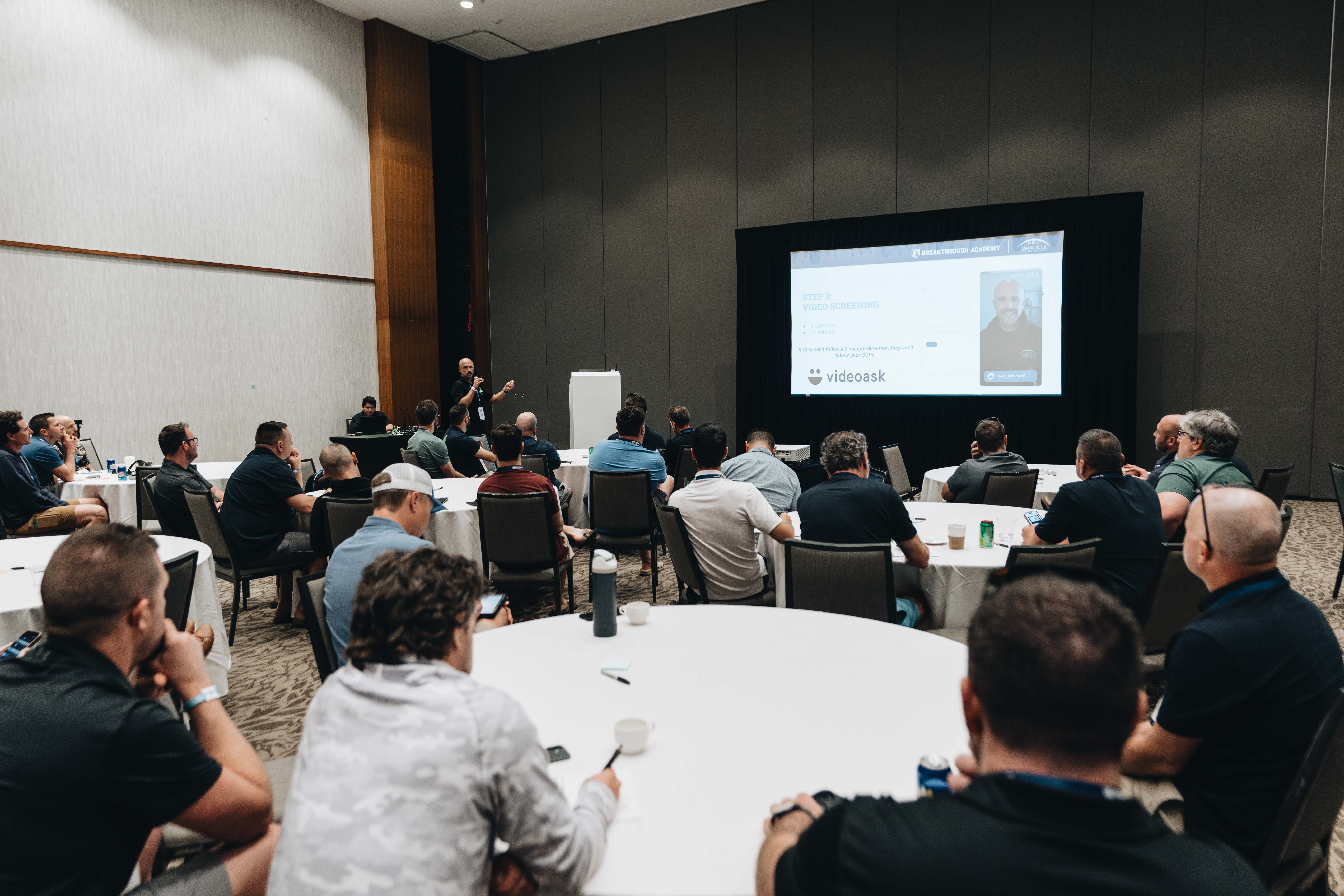
At Breakthrough Academy’s Winter Summit, Ryan Lermitte, Founder of Umbrella Property Services, shared how expanding beyond local hiring helped his company grow past $1.4M while protecting margins and expanding leadership capacity.
The shift wasn’t random outsourcing. It was building a disciplined system for hiring and managing remote team members, such as virtual assistants.
Here’s how he did it.

What are construction virtual assistants?
A virtual assistant (VA) is an individual who specializes in repeatable back-office tasks and administrative support for the construction industry. They often work remotely and can be hired on a temporary basis.
What can virtual assistants do?
Construction companies carry a heavy administrative burden that can be drastically lightened with the help of construction VAs. Frequent virtual assistant tasks include:
- Customer service support
- Dispatch and scheduling
- Invoicing and accounts receivable follow-up
- Data entry and CRM updates
- Marketing support, such as social media management
- Executive or personal assistant tasks
These functions are critical, but they don’t require your highest-value people. But an efficient VA can help streamline operations like these.
The Mistake Most Contractors Make
When contractors try hiring a construction VA for the first time, many tend to do the following:
- Post a vague job ad
- Review a handful of resumes
- Conduct one interview
- Hope for the best
That’s not a hiring system. That’s a gamble.
Remote hiring requires more attention than local hiring because you don’t have the benefit of being able to observe the candidate in-person. Even if it’s just someone to cover administrative support, you still need a multi-stage hiring process that filters carefully and protects standards.
Where to find virtual assistants for contractors
If you limit your hiring pool to your city limits, it shrinks your options and increases payroll pressure. But if you expand your options globally, it increases flexibility and access to talent while keeping overhead under control. Basically… venture beyond your own backyard.
There are companies that can connect you directly with pre-vetted construction VAs, but with a good system in place you should be able to find someone with the right skillset on your own.
A proven 7-step process for hiring a virtual assistant
Breakthrough Academy has coached many construction contractors through the process of implementing a solid hiring system. And it’s also relevant for hiring remote staff.
Here’s what it entails:
Step 1: Write a specific, outcome-focused job ad
Generic ads attract generic applicants.
Instead of “Construction Admin Needed,” define clear deliverables and expectations. High performers are drawn to clarity and challenge.
Be sure to outline:
- Responsibilities
- Work hours
- Tools required
- Performance standards
Specificity filters out people who aren’t serious. If you could use a starting point with writing the job posting, we’ve got a Quick Tool that will help you clarify exactly who you’re looking for.
Step 2: Use a structured application form
Never accept resumes by email.
Require every applicant to complete a detailed form. It immediately eliminates any candidates who fail to follow instructions.
Consider including:
- Knockout questions (internet speed, equipment, English fluency)
- A short video requirement
- A hidden instruction to test attention to detail
Remote work demands discipline. Your process should test for it early.
Step 3: Request time-limited video responses
Ask applicants to submit a SHORT video answering specific questions. Why give them a strict time limit?
Because it helps evaluate their:
- Ability to communicate clearly and succinctly
- Confidence levels
- Ability to follow directions
- Professional tone
If someone can’t follow simple constraints during hiring, you can bet they’ll struggle once they get hold of your SOPs.
Step 4: Validate skills and technical expertise
Before you interview, verify they have the skillset and capabilities you need.
If relevant, ask candidates to submit evidence of:
- Typing test results
- Internet speed verification
- Photos of their workspace
Then assign a small, role-specific task, such as:
- Record a mock customer call
- Complete some sample admin paperwork
- Create some sample marketing content
☝️Remember, though… you’re testing ownership and problem-solving — not perfection.
For more on how Ryan fine-tuned his hiring process, take a look at the full Breakout Session.
Step 5: Conduct a focused interview
The interview is not about repeating their resume. It’s about understanding ambition and alignment.
Ask behavioral-based questions that reveal their:
- Experience handling difficult situations
- Long-term thinking
- Personal goals
You want people who take growth seriously and have a mindset that will meld with your company’s values.
This Interview Guide will help set you up to hold informative and productive interviews, even if they’re conducted online.
Step 6: Paid Trial Day
Once you’ve narrowed down your best prospects, hire them for a day to see how they work.
A paid trial day reveals more than any interview. You’ll get a sense of their:
- Work speed
- Responsiveness
- Initiative
- Coachability
If there are performance issues, best to discover them early.
Step 7: Structured Onboarding and Accountability
So… you’ve selected your virtual assistant. (Congrats, btw! 🎉If you followed this plan, they’re no doubt awesome.)
Now what?
Now you set them up for success. How? By giving them the following:
- An employee agreement that clearly lays out the expectations and performance incentives for their role.
- A thorough and consistent onboarding experience (hint: use a training checklist!)
- Regular Goal Setting and Review (GSR) sessions to instill accountability and ownership
- Access to your company’s SOP library. (You do have SOPs, right?)
FAQs about construction virtual assistants
If you’re not accustomed to working with remote staff, the whole notion probably raises a few questions. Never fear. We’ve got answers.
Will construction customers notice they’re dealing with a virtual assistant?
Customers care about responsiveness and professionalism — not geography. If calls are answered promptly and issues are resolved efficiently, location becomes irrelevant.
What about reliability when it comes to VAs?
Local employees quit too. Reliability comes from setting clear standards, providing a structured onboarding, and maintaining consistent communication.
People are people. It’s your systems that determine performance.
Should I worry about security with virtual assistants?
Modern tools — cloud systems, VoIP platforms, and access controls — provide strong oversight and instant access removal when needed.
Security is a process issue, not a location issue.
Final thought: Build the system first
Hiring remote support is not a shortcut. It’s a strategic move.
If you build a disciplined hiring process with clear filters, paid trials, and strong accountability, you dramatically increase your odds of long-term success.
The contractors who scale sustainably aren’t the ones working harder. They’re the ones building systems that let them lead.
If you’re ready to install that kind of structure inside your construction business, Breakthrough Academy works with growth-minded contractors across North America to build scalable systems that drive profit, stability and freedom.
Watch the full Breakout Session today to learn more about Ryan’s journey with using virtual assistants to streamline his operations.


Get in touch today!
Table of Contents

Get in touch today!


The business coach that lives in your inbox



You’ve built something great. Let’s make it amazing.
Ready to take your business to the next level? Let's chat.
Curious how the program will work for YOU?
You have all the right pieces of the puzzle.
We’ve helped over 1,900 contractors just like you
You don’t need to build it by yourself.
The time is now.
Over 1,900 Contractors have built businesses they’re proud of with Breakthrough Academy.
Systemizing your business is a lot of work. NOT doing it is even more.
Systemizing your business is a lot of work. NOT doing it is even more.
If you’ve read this far, it's safe to say you’ve already tried a bunch of stuff.
