
How to Build a Strategic Plan: A Simple 1-Page Framework for Contractors
Learn how to build a strategic plan using a clear 1-page framework designed for construction and trades businesses.
How To Build a Strategic Plan: A Practical Framework for Growth-Minded Contractors
If you run a construction or trades business, you already know this: the gap between the business you imagine and the business you run day-to-day can feel enormous.
Most contractors have the ideas. Many even have the ambition. But very few have a clear, simple, 1-page strategic plan that takes big-picture vision and turns it into specific, measurable, week-by-week execution.
In this guide, pulled from our recent strategic planning web class with Breakthrough Academy co-founder Danny Kerr and long-time builder Tom Cumming, you’ll learn how to build a one-page strategic plan you can actually follow — without drowning in spreadsheets, 50-page business plans, or endless “planning sessions” that go nowhere.
This is the exact system Breakthrough Academy members use to grow past plateaus, professionalize operations, and consistently hit long-term goals.
What You’ll Learn
This blog walks you through:
- Why your why (mission, values, purpose) drives the entire strategic planning process
- How to set long-term vision (3–5 years) you can confidently communicate
- How to turn that vision into a 1-year plan with specific measurable targets
- How to break annual goals into quarterly strategic priorities and weekly actions
- How real contractors apply this method to grow — including Tom’s journey from plateauing at $4.5M to consistent profitability
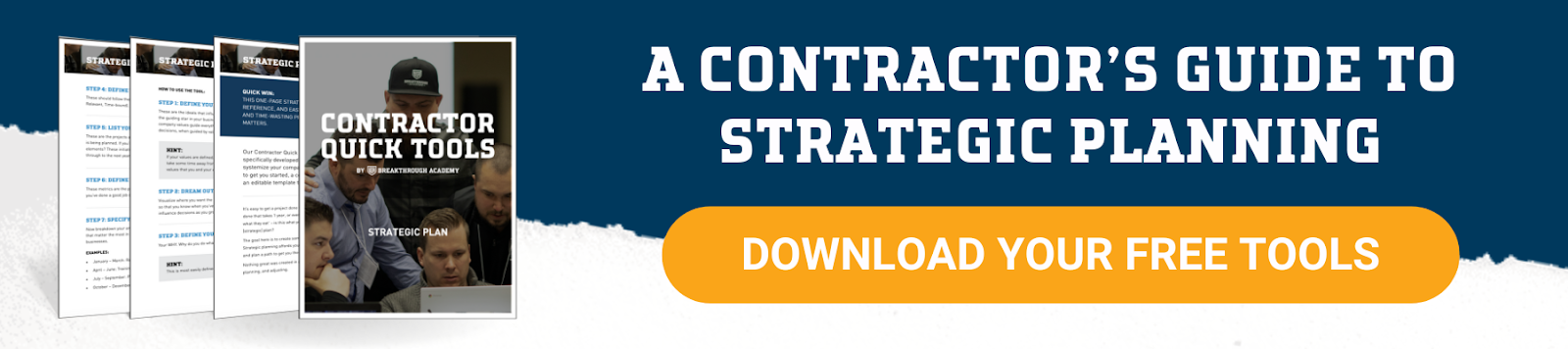
Before you dive in, be sure to grab the strategic planning resource bundle we gave away in our recent web class so you can get started right away
The Big Idea: Strategic Planning Aligns the Future With the Day-to-Day
This framework helps you move from:
- Reactive (“Put out fires, repeat, hope next year will be different”)
to - Proactive (“Clear direction, measurable goals, predictable execution”)
Let's break it down.

1. Start With the Big Picture: Your Why, Values & 3-Year Vision
Most contractors skip this step. They jump straight to yearly revenue targets or to-do lists. But without clarity of purpose, your strategic plan becomes random.
Danny’s recommendation: begin with three foundational elements.
Your Why
This defines the deeper reason you chose this industry, your company, and this life.
For Tom Cummings, a Toronto custom builder, his why evolved over time: from needing income, to caring deeply about staff, to wanting to be respected as a leader in the industry.
Your own why should be personal, practical, and aspirational.
Core Values
Values guide:
- Who you hire
- Who you fire
- What customers you say yes or no to
- How you behave during hard decisions
Values are less about words on a wall and more about making tough calls easier.
Examples of Tom’s values include integrity, transparency, customer focus, and excellence. And they matter. Especially when someone on the team performs well numerically but damages culture or client trust.
The Painted Picture (3-Year Vision)
The painted picture (also known as a Vivid Vision) exercise answers:
“What does my company actually look like three years from now?”
You write it like a speech you’ll read at a future company dinner:
- Revenue
- Team structure
- Profit
- Customer experience
- Culture
- Your role as an owner
- Personal life (time freedom, finances, etc.)
Danny shares that every time he’s read his Painted Picture years later, he’s shocked by how much came true — even details he forgot he wrote down. Because writing vision down forces clarity… and clarity accelerates momentum.
2. Build Your Annual Strategic Plan (Your 1-Page Roadmap)
Once your long-term vision is set, you zoom into the next 12 months.
Your annual plan has two parts:
Annual Targets (Your SMART Numbers)
These are:
- Specific
- Measurable
- Attainable
- Relevant
- Time-bound
Targets typically include:
- Revenue
- Gross profit %
- Gross profit dollars
- Net profit %
- Individual department or role targets
- Quality & efficiency metrics
Tom’s 2024 plan, for example, wasn’t random:
He used historical performance, realistic capacity, average job size, and backlog analysis to set a $9M revenue target with expected margins. He ended up hitting $11.6M with higher-than-planned gross profit.
The magic wasn’t luck. It was planning, tracking, and adjusting early.

Annual Initiatives (Strategic Projects)
Annual initiatives are the 3–7 big projects that move the business forward.
Examples:
- Rolling out a design-build process
- Hiring a pre-construction estimator
- Implementing a new marketing campaign
- Building SOPs for project handoff
- Creating a training program for PMs
- Dialing in job costing
- Improving recruitment & onboarding
These aren’t tasks — these are business-building projects that take months.
The criteria Danny recommends:
- Does this initiative support the long-term vision?
- Is it necessary for us to hit our numbers?
- Can we realistically complete it this year?
- Will this have meaningful ROI?
This step forces your business to stop reacting and start building.
3. Quarterly Planning: The Most Important Rhythm for Execution
Plans rarely survive the real world. Quarterly planning is where your plan stays alive.
Every 90 days, you:
- Review progress vs. plan
- Analyze what worked, what didn’t, and why
- Update sales forecasts
- Look at financial trends
- Re-prioritize initiatives
- Set a new list of “Quarterly Rocks” (your top 3–5 most important projects)
Tom emphasizes that his plan changes, but the long-term goals don’t:
Why quarterly beats annual planning:
- It keeps your team aligned
- It prevents drift
- It forces adjustments early
- It creates urgency
- It builds momentum every 90 days
Many Breakthrough Academy Members block two full days offsite each quarter to do this properly.
4. Weekly (or Bi-Weekly) GSR: Where Strategy Meets the Day-to-Day
GSR = Goal Setting & Review
This is where you sit down with your key people and:
- Review last week’s results
- Compare to annual targets
- Identify roadblocks
- Coach the right behaviors
- Confirm priorities for the upcoming week
It transforms you from a micromanager into a coach.
Danny explains that this rhythm ensures your team isn’t just busy — they’re moving the company toward the strategic plan:
“It becomes the difference between doing whatever comes up on a Tuesday vs. doing the thing that moves the company closer to its future.”
Owners who implement GSR consistently see:
- Better margins
- More autonomy among staff
- Fewer balls dropped
- Less firefighting
- More accountability
- Higher job satisfaction for everyone
This is one of the highest-ROI habits a contractor can install.
Real-World Example: How Tom Broke a 10-Year Plateau
For the first decade of his business, Tom admits:
- He winged everything
- He had no strategic plan
- Revenue stayed stuck around $4.5M
- Margin fluctuated
- He wasn’t tracking financials well
- Growth was unpredictable
When he joined coaching and later Breakthrough Academy:
- He built a 1-page plan
- Created systems
- Implemented quarterly planning
- Added weekly goal setting
- Started tracking numbers monthly
- Hired intentionally
- Improved marketing and lead flow
The result?
- Revenue grew to $11.6M
- Gross profit improved
- Net profit improved
- Consistency improved
- Accountability improved
- Team performance and retention improved
He even implemented profit-sharing and long-term staff incentive structures, because margins were now predictable and stable.
This is the power of strategic planning done right.
Putting It All Together: Your 1-Page Strategic Plan Structure
Here’s the simple structure you’ll use:
SECTION 1: The Big Picture
- Why
- Core Values
- 3-Year Painted Picture
- BHAG (Big Hairy Audacious Goal)
SECTION 2: Annual Plan
- Annual SMART Targets
- Annual Initiatives (Strategic Projects)
- Annual Budget (Revenue → GP → Overhead → Net Profit)
SECTION 3: Quarterly Plan
- Quarterly Rocks
- Sales Plan & Forecast
- Financial Trends & Leading Indicators
SECTION 4: Weekly GSR
- Individual team targets
- Weekly reviews
- Coaching conversations
- KPI dashboards
- Accountability rhythms
When all four layers work together, you get to start meaning your company like one large project instead of a chaotic pile of smaller ones.
Avoid These Common Strategic Planning Mistakes
These are the traps most contractors fall into:
❌ Mistake #1: Building a massive plan no one follows
Your plan must fit on one page, or it won’t get used.
❌ Mistake #2: Setting revenue goals without supporting systems
A number without a plan is a wish.
❌ Mistake #3: Only reviewing the plan once a year
Quarterly = essential
Weekly = where execution happens
❌ Mistake #4: Doing everything yourself
Owners who refuse to delegate stay stuck.
❌ Mistake #5: No financial dashboard
If you’re not tracking numbers monthly, you’re driving blind.
Want Help Building Your 1-Page Strategic Plan?
If you want a deeper dive into the fundamentals of construction business planning, check out this related guide:
👉 How to Create a Construction Business Plan
It pairs perfectly with the 1-Page Strategic Plan framework and gives you a full blueprint for professionalizing and scaling your contracting company.
Final Thoughts: Focus on Progress, Not Perfection
You don’t need to master the whole system at once.
Start with:
- 1 clear vision
- 1 set of annual targets
- 1–3 quarterly priorities
- Weekly check-ins with your people
As Danny reminds us:
“You only need five hours a week working on the business to completely transform it.”
And as Tom reminds us after 22 years in construction:
“Had I started this in year two of business, my life would look a hell of a lot different.”
Start now. Your future business will thank you.
You may also like


Get free tools & resources


You’ve built something great. Let’s make it amazing.
Ready to take your business to the next level? Let's chat.
Curious how the program will work for YOU?
You have all the right pieces of the puzzle.
We’ve helped over 1,900 contractors just like you
You don’t need to build it by yourself.
The time is now.
Over 1,900 Contractors have built businesses they’re proud of with Breakthrough Academy.
Systemizing your business is a lot of work. NOT doing it is even more.
Systemizing your business is a lot of work. NOT doing it is even more.
If you’ve read this far, it's safe to say you’ve already tried a bunch of stuff.
