


How to Hire a Leadership Team as a Contractor Business Owner

Table of Contents

Get in touch today!
No longer have the bandwidth to function as your company’s “everything”? It’s time to build a strong leadership team. Here’s how to do it without breaking your business.
Key Takeaways:
- Recognize that leading your team effectively might mean getting out of your own way.
- A well-defined organizational chart is an essential tool for contractors.
- Handle the leadership transition like a smooth hand-off during a construction project – timing and planning are crucial.
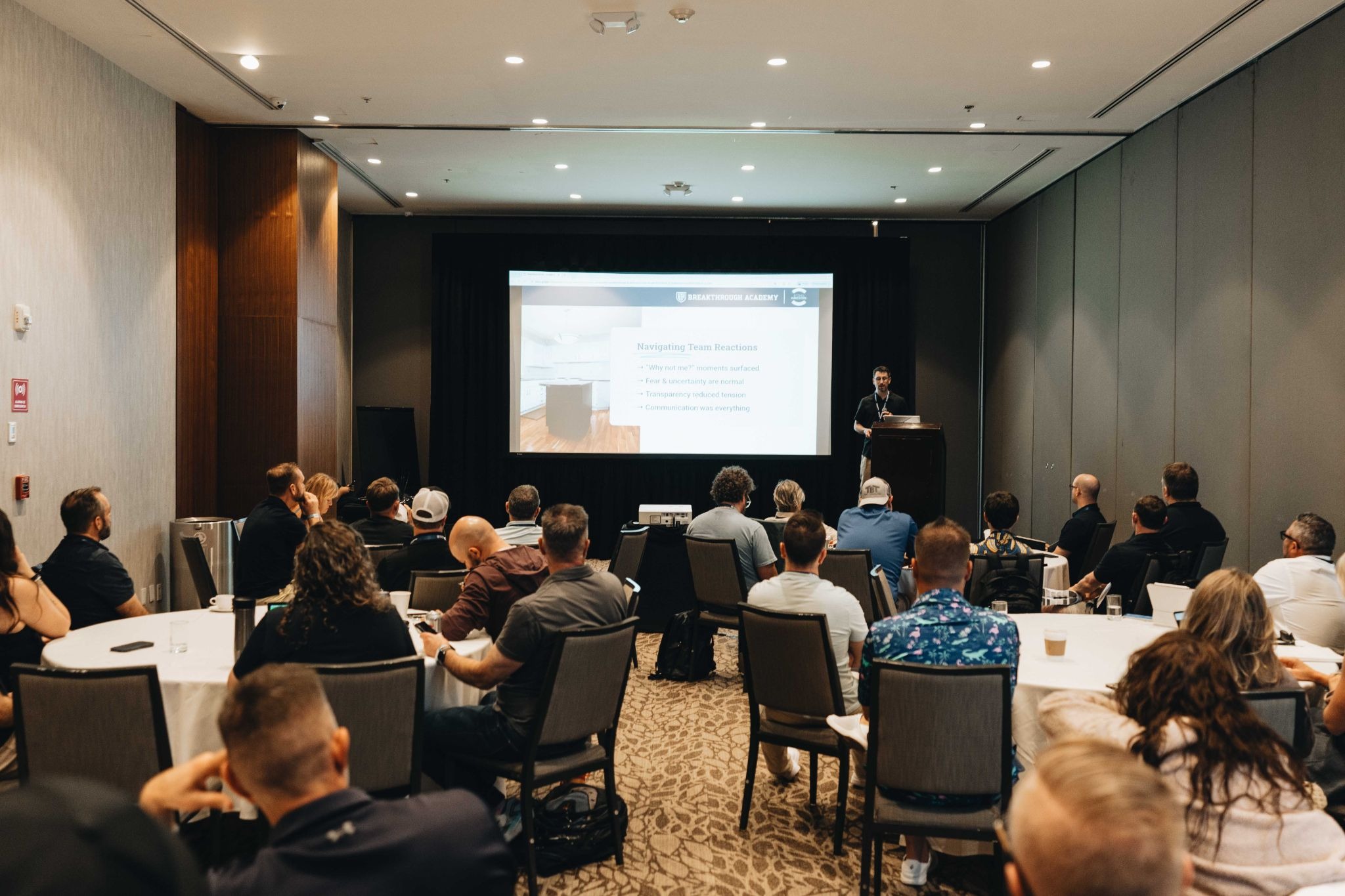
At Breakthrough Academy’s Winter Summit 2026, Johnny Alvernaz, owner of Kitchen Makeovers and Breakthrough Academy Member, shared how he transitioned from being the bottleneck in his business to building a leadership structure that unlocked scalable growth.
But Johnny didn’t just hire a general manager.
He redesigned the company’s organizational structure such that it would allow them to grow from $4M to $8M, and eventually achieve his long-term vision of becoming North America’s largest cabinet upcycling company.
If you're a contractor stuck in the “owner-operator trap,” this framework shows how to hire a general manager, or other team leader, without hurting performance, culture or profitability.
The real problem: the owner as the obstacle
Johnny successfully grew his company from $300K to $4M in revenue, but during a strategic planning session, a hard truth surfaced:
The systems that got him to $4M would not get him to $8M.
Like many contractors, Johnny’s job description was:
- Owner
- General Manager
- Chief Firefighter
- Final decision-maker on every major function
Not to mention sales, operations, project management, production and admin.
Everything rolled up to him.
The result? He was burnt out, his focus suffered and he had limited time to devote to strategic business decision-making.
If you’re working 60+ hour weeks for your construction business and still feel behind, Johnny’s situation may sound familiar. However, before you rush out and hire a general manager, you need to acknowledge the real issue:
There’s only so much of you to go around. Your constraint is capacity, not effort.
3 steps for a successful leadership transition
Here’s the framework Johnny used for hiring a general manager to help run the day to day operations in his company.
1. Define the reporting lines
Instead of relying on a recruitment firm, Johnny spent time considering an important question:
What structure does the business need to achieve our vision?
He then drew two org charts: a current one that showed which roles currently existed; and a future one that defined what was needed, as well as the reporting relationships between them.
This immediately highlighted the gaps Johnny had to fill amongst his team members.
In the new structure:
- All core functions reported to a General Manager
- The GM reported to Johnny
- Johnny shifted into CEO / visionary role
2. Design the role
Many leadership transitions fail because expectations are vague. Johnny avoided this by defining his GM’s role in detail before formally moving anyone into it.
He clarified the role’s responsibilities, including:
- Which decisions the GM owns
- What KPIs they are accountable for
- What outcomes define success
- What budget lines they control
- How compensation ties to performance
Basically, he figured out all the details he’d need to create an enticing job posting and an employment agreement that clearly set the expectations for the role.
ONLY THEN did he start thinking about WHO might be best placed for the job.
💡Remember: ambiguity kills performance, while clarity creates alignment.
3. Treat the transition like a project
Ultimately, Johnny identified Andrew, his top sales performer, as the right candidate.
Now here’s where most contractors get into trouble. They promote someone on Friday. They announce it on Monday. Then they hope it all works out.
Instead, Johnny built a detailed work-back plan.
He asked:
What must be true before Andrew can safely step into this role?
That meant:
- Backfilling Andrew’s sales seat
- Hiring and training a new salesperson
- Working the GM’s compensation into the budget
- Planning leadership communication
- Gradually shifting responsibilities
- Protecting sales performance
Nothing moved forward until the previous dependency was handled.
The result?
- Sales didn’t drop
- Production didn’t stall
- The transition felt calm, not chaotic
Learn more about Johnny’s journey to rebuilding his leadership structure in the full Breakout Session.

Timing is everything
Johnny chose the timing around the transition carefully. It wasn’t emotional – it was strategic. Before initiating the move, his team spent the year improving gross profit margins by 6%. That gain created the financial capacity to afford a GM.
He didn’t hire based on stress. He hired based on data.
If you're considering hiring a general manager, ask:
- Can gross margin improvements fund this?
- What does the sandbox scenario in our budget say?
- What’s the cost of inaction?
The truth is the cost of not building leadership depth is higher than the salary of the leader. That said, if you’re going to do it, make sure you’re financially ready.
Navigating rough roads
Even with careful planning, leadership transitions can create tension. Here’s what Johnny encountered, and how you can prepare for similar challenges.
Team reactions: “Why not me?”
Another high-performing leader in Johnny’s company had hoped for advancement, and promoting Andrew required a difficult conversation.
The org chart became the anchor and instead of feeding emotions, Johnny pointed to:
- Business needs
- Long-term vision
- Future opportunities created by this structure
High performers don’t necessarily need everything to feel comfortable. They need it to make sense.
Clarity builds trust.
Shifting from operator to leader
This was Johnny’s biggest internal challenge. For years, his value came from solving problems. Now, his job is to build and coach the person solving the problems.
Successfully shifting into a leadership mindset requires:
- Letting others make decisions
- Accepting short-term imperfection
- Trusting structure over ego
It’s inevitable that you’ll encounter a difference in management styles, but if you don’t let go, you undermine the leader you just hired. And if you step back too early without a supportive structure in place, you create chaos.
Balance is found through:
- Clear accountability
- Defined KPIs
- Structured decision frameworks
- Coaching rhythms
The impact: set for expansion
After the leadership transition was complete and Andrew was settled into his new role as General Manager, Johnny noticed some marked improvements within the business:
- Decision-making accelerated
- Team clarity increased
- Bottlenecks decreased
- His strategic capacity expanded
Most importantly: The business no longer depended entirely on him.
Before the move, opening a second location felt irresponsible. Afterwards, expansion became structurally possible.
The business now has:
- Leadership depth
- Defined ownership
- Clear accountability
- Capacity at the top
- Improved quality control
That’s what happens when growth is built on solid org structure – not frantic hustle.
Ready to stop being the bottleneck in your business?
At Breakthrough Academy, we help contractors design leadership structures to unlock growth — without burning out the owner or breaking the business.
If you’d like to learn more about how Johnny did it, watch the full Breakout Session today.


Get in touch today!


The business coach that lives in your inbox


You’ve built something great. Let’s make it amazing.
Ready to take your business to the next level? Let's chat.
Curious how the program will work for YOU?
You have all the right pieces of the puzzle.
We’ve helped over 1,900 contractors just like you
You don’t need to build it by yourself.
The time is now.
Over 1,900 Contractors have built businesses they’re proud of with Breakthrough Academy.
Systemizing your business is a lot of work. NOT doing it is even more.
Systemizing your business is a lot of work. NOT doing it is even more.
If you’ve read this far, it's safe to say you’ve already tried a bunch of stuff.
