


Sales and Marketing Systems for Contractors
To get leads and close deals, contractors need tactics designed to help overcome the various sales and marketing complexities specific to the trades.


Table of Contents

Get in touch today!
Quick Snapshot
- Before you spend a penny on marketing, calculate what your marketing budget should be based on your average job size and customer acquisition cost.
- There are a range of marketing tactics you can apply. Choose the ones that make most sense for your budget and business.
- Make sure you’ve got a good tracking system in place to determine which marketing channels are generating the most quality lead conversions.
How much should I spend on marketing?
Figuring out your marketing budget should not be guesswork, but knowing how much you can afford to spend starts with having a clear budget. From there it’s a matter of:
- Considering a few key factors
- Doing some simple math
Here’s how to figure out what sort of marketing budget you’ll need to reach your revenue goals:
Step 1: Set your target revenue
This is pretty straightforward. How much are you aiming to bring into the company this year?
Step 2: Dig into your data
Figure out your metrics to get a sense of how your current marketing efforts are contributing to your success, including:
- Customer Acquisition Cost (CAC) = the amount you spent on sales & marketing divided by the number of customers landed
- Customer Lifetime Value (CLTV) = total revenue you’re likely to earn from a customer over the entire length of the relationship
- Profitability = your gross and net profit margins
Step 3: Identify your growth phase
Companies should allocate different amounts to their marketing depending on their growth phase. Marc Levesque, whose company Webrunner specializes in contractor marketing, recommends the following budget levels:
- Startups and growth-oriented companies probably want to devote 10-20% of their revenue to marketing.
- Mature and established companies are probably okay allocating 5-10% of their revenue to maintain their position in the market.
Step 4: Account for market factors
You’ll want to think about the following:
- Competitive Landscape – If you’re in a highly competitive environment, you’ll likely need to devote a slightly higher percentage of your revenue to marketing.
- Marketing Objectives – if you’re focused on building brand awareness, you’ll also want to be on the higher end in terms of what you budget for marketing.
Step 5: Crunch the numbers
Let’s say you’re working to grow your contracting business and have the following metrics:
- Intended revenue = $5M
- CAC = $1500
- Average job size = $20K
That means you’ll have to:
- Sell 250 jobs ($5M/$20K)
- Spend $375K (250 x $1500) on marketing
This puts your marketing budget at 7.5% of your revenue, which would be on the low end for a growth company. You should expect to spend at least 10% or $500K.
How to market a trades company – the essentials
Now that you know how much money you’ve got to work with, you can get into the fun stuff… deciding what to do with it. Here are seven marketing ideas to start with.
Create your Google Business Profile
A Google Business Profile makes your company easier to find when customers do Google searches or enter your company name in Google Maps. It provides them with quick details, like your location, address, hours and – this is crucial – reviews that speak to the quality of your work.
Collecting 5-star reviews does wonders for your search ranking and visibility online, so it’s worth giving this some focus.
Get found in AI searches
A dedicated company website functions as the online home for your brand, but should also be designed to convert visitors to customers.
Besides showcasing clear value propositions and calls-to-action (CTAs), your site needs to use SEO best practices AND appeal to AI-assisted searches.
Add a self-service estimator
An automated quoting tool on your website allows the customer to enter their contact details and then answer a few questions to provide enough high-level information, like square footage, for the tool to calculate a rough estimate.
As product delivery seems to be reaching warp speed, customers have become accustomed to getting what they want when they want it… which is typically NOW.
If a potential client is looking for a quote, they want a ballpark number as quickly as possible. The concept is known as “speed to lead” and contractors who understand it will rocket ahead of their competition.
According to Marcus Sheridan, business expert and author of They Ask, You Answer, 75% of buyers prefer to avoid dealing with a salesperson until they’re ready. Self-service or interactive tools, like an automated estimator, provide a perfect solution.
“The way that you can address [a modern buyer] is through what we call self-service. Self-service are tools on your website—interactive tools that allow a prospect to take an action or get an answer that previously they would have had to have gotten by talking with a human first.”
- Marcus Sheridan, Author: They Ask, You Answer.
Integrate an AI chatbot
A text-based chat widget can help answer questions, capture qualified leads or direct visitors to the estimator. People are busy and often prefer not to have to dig through a website to find what they’re looking for. Use tech to help save them time.
Answer your phone
How many calls have you missed this week? We’re gonna guess it’s not zero.
Despite all the recent advances in AI, there will be customers who still prefer to reach out and talk to someone directly.
When they call… ANSWER!
But make sure you either have someone on your team prepared to field these calls, or use an answering service that can forward it to someone able to jump into the discussion.
This helps your marketing maintain a human touch but it’s often an overlooked tactic, which is a shame because customer calls are one of the easiest conversions to get. Anyone calling is likely already about 80% into the buyer’s journey. They’ve researched your company, they know what they want, they’re ready. Make sure you are too.
Leverage social media
This is kind of a given at this point, but you’ll also want to build a presence on social media platforms. Be careful about overextending your marketing resources where social is concerned. You don’t need to be on EVERY platform, and you don’t need to plough straight into paid ads either. Start by creating organic content and seeing what earns engagement, then run ads based on what proves to work for your brand.
Maintain a physical presence
While it’s not enough to just drive around with your name on a truck, it definitely doesn’t hurt to paint the town with your brand, as it were.
Everything from vehicle wraps, signs, door hangers and your team’s uniform work together to make your marketing memorable.
Learn more about the art of home improvement sales with expert Marcus Sheridan in this webinar only available to Breakthrough Academy Members (and you, because you’re reading this blog).

How to market a trades company – advanced strategies
Now that we’ve covered the essentials, we’re gonna hit you with some things you can do to take your marketing efforts to the next level.
The tactics mentioned here are all extremely effective, but only if you’ve got the basics in place first. One step at a time.
Marketing automations
After you’ve captured a qualified lead… don’t stop there! Keep the conversation going to build trust with the prospective customer and give them a sense of who you are and how you operate.
Authenticity is important, but so is speed. To put that into perspective, when someone has filled out a form, assume they’ve requested multiple quotes. You need to hustle to get in touch and turn them into a qualified lead., which means… you’ve entered the “race to the face.”
Automations can help manage this process by:
- Sending an initial email or text, whichever the potential client has identified they prefer, asking for a photo of the problem to help fine tune the quote.
- Following up with messages (if there’s no reply) asking if they’ve managed to resolve their issue.
- Creating calendar reminders for the salesperson to call the potential client and check in to see if they’re still looking for info.
Automations proved a massive game-changer for Cory Byron, helping bring his company, VanCity Electric, to the top of the search results in his region.
Social selling
Social selling isn’t just about posting on social media. It goes way beyond that. This tactic involves sending out a direct message to a follower on a social platform to inquire about how you might be able to help them.
There are a bunch of SaaS products out there that can automate this process, but here’s the thing: you can’t just message people out of the blue. You first must put the work into building a library of valuable content that engages those followers to begin with. And THAT takes time and effort. This tactic is not for novices.
Content marketing
While you’ll likely want to explore various forms of content, video is becoming increasingly popular and is particularly effective at building trust as it allows people to see your face and hear your voice. Basically, get to know your brand.
Make sure you’re speaking to your customers and addressing the actual questions that tend to arise during interactions about projects.
Pick up expert tips on how to build a stellar sales funnel in this members-only webinar.
How do I track which lead sources are working?
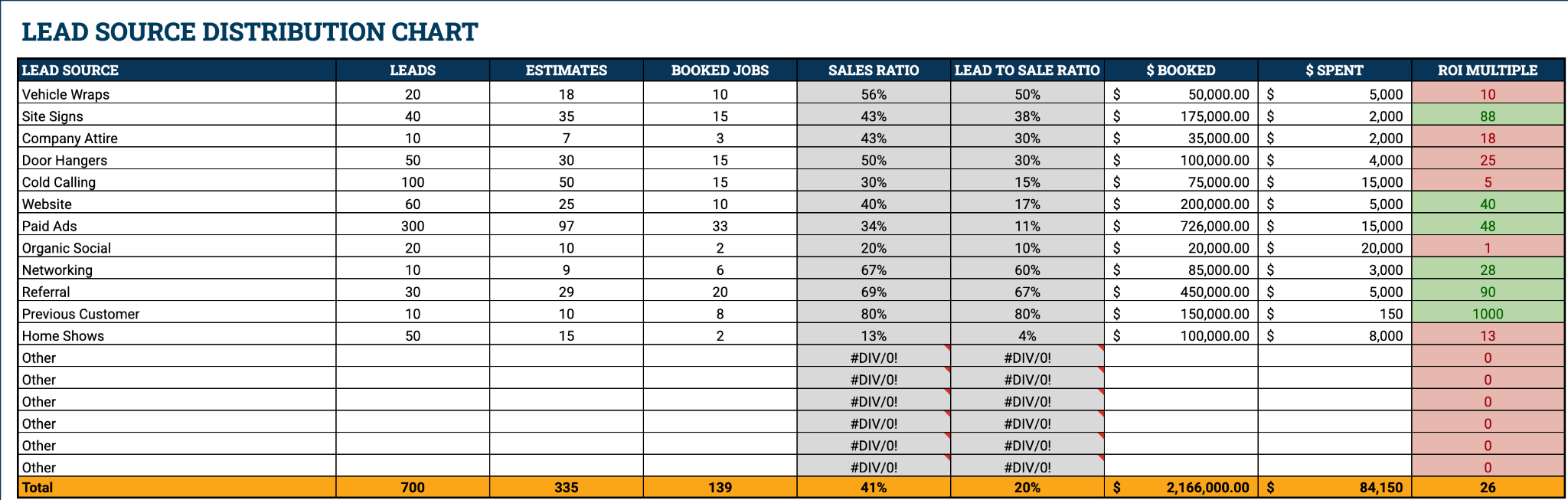
This is a pivotal question, and often a tough one for contractors to answer. This is why Breakthrough Academy created this Lead Source Distribution Chart, which helps you track:
- Where your qualified leads are coming from, such as via referrals, your website, your YouTube channel, social media platforms, local advertising, print or your vehicle wrap.
- How many of the leads from each source turn into estimates and jobs.
Tracking the source of a lead can be a little complicated if the prospective customer has had multiple touchpoints with your brand. For example, if they saw your truck at a neighbour’s, looked up your website, and then watched a few videos on your YouTube channel…
Which source gets the credit for bringing them in?
Do your best. Ask how they heard about you, and they’ll likely mention either their first or most impactful encounter with your brand. Track whichever they identify, that means it worked.
A lead source tracking tool will help you calculate your:
- Sales Ratio – the percentage of estimates that became jobs
- Lead to Sales Ratio – the percentage of leads that became jobs
- ROI – the value of the job versus how much you spent on that marketing source
You’ll readily see which sources are the most effective and which may not be worth the investment. Protect your resources and focus on what works.
Frequently asked questions


Get in touch today!


The business coach that lives in your inbox



You’ve built something great. Let’s make it amazing.
Ready to take your business to the next level? Let's chat.
Curious how the program will work for YOU?
You have all the right pieces of the puzzle.
We’ve helped over 1,900 contractors just like you
You don’t need to build it by yourself.
The time is now.
Over 1,900 Contractors have built businesses they’re proud of with Breakthrough Academy.
Systemizing your business is a lot of work. NOT doing it is even more.
Systemizing your business is a lot of work. NOT doing it is even more.
If you’ve read this far, it's safe to say you’ve already tried a bunch of stuff.
