


Ep -
291
59 min
How To Implement AI Without Losing Your Mind [For Contractors]
If you’ve spent any time playing around with Claude, ChatGPT, Gemini etc., you’ve probably noticed how easy it is to put a ton of work into something that ended up being inaccurate, too complicated or more work than it’s worth. Tyler Folkman has worked in AI for almost 20 years, and in this podcast episode, he shares the roadmap for using AI in ways that actually benefit our business, our people, and our bottom line.

AI can write emails, analyze data, build apps and automate workflows faster than most contractors would have imagined a few years ago.
But just because you can build something with AI doesn’t mean you should.
In this episode of Contractor Evolution, Danny Kerr sits down with Tyler Folkman, Chief AI Officer at JobNimbus, to talk about how contractors can use AI to make their businesses more efficient without creating a mess of unreliable tools, bad data and complicated automations.
Tyler has spent years working in AI and data science, and his advice for contractors is surprisingly simple: solve real problems first, then let AI help you improve the system.
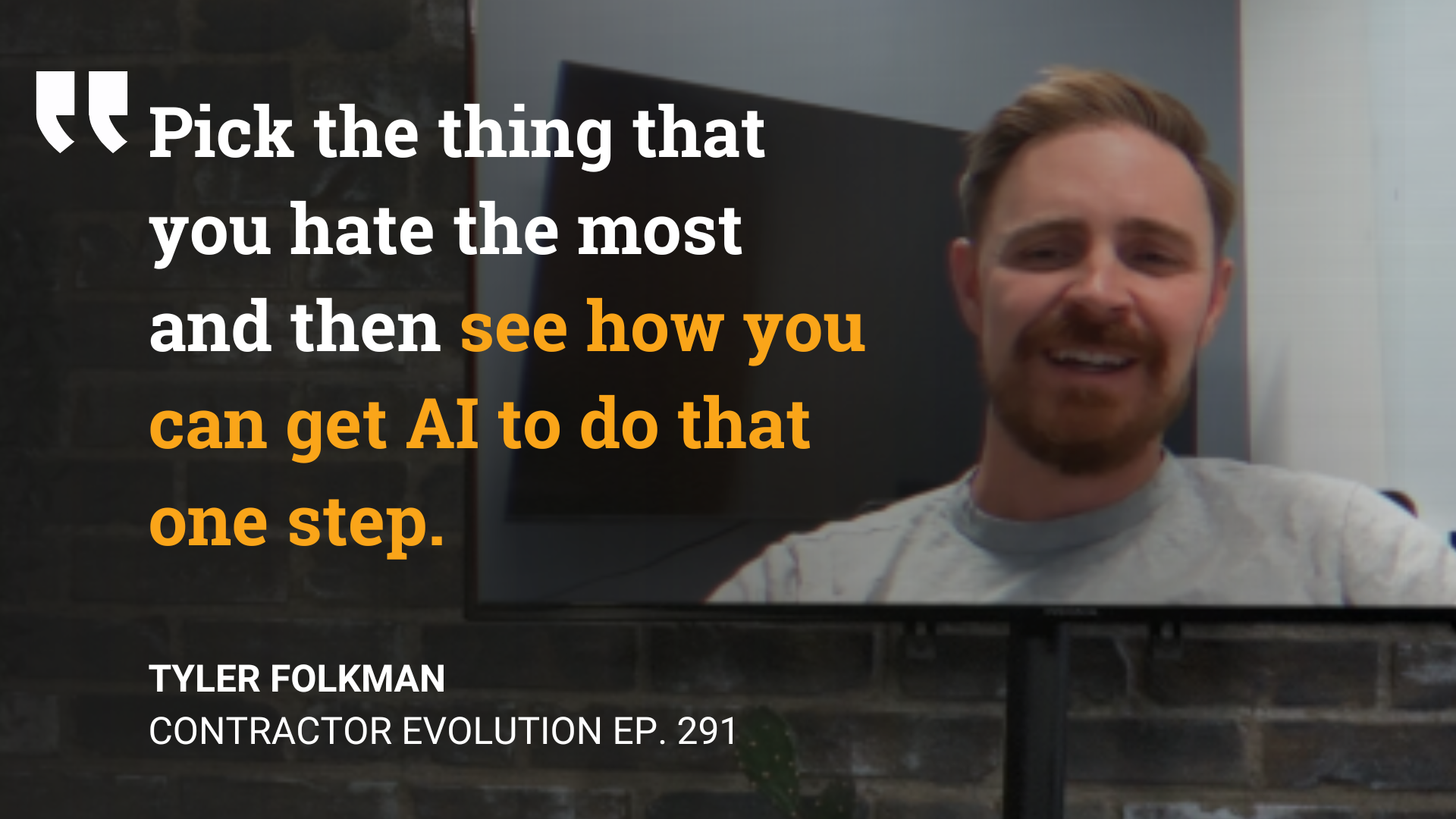
4 Takeaways For Contractors Using AI
- Follow the pain instead of chasing the technology. Start with a specific bottleneck that’s already costing you time. Maybe you’re missing incoming calls, spending too long building estimates or manually updating your CRM. Solve one problem first, see what happens, then decide what to automate next.
- Start with the smallest useful version. AI makes it tempting to automate an entire workflow at once. Tyler warns that this creates more places for things to break. If your problem is missed calls, for example, start by having an AI model answer the call and capture the information you need. Don’t try to automate the entire customer journey overnight.
- Give AI better context. Generic prompts tend to generate generic answers. The bigger opportunity is connecting AI to the information that makes your business unique. This could be your processes, CRM data, financials, SOPs and internal knowledge. Tyler suggests creating a centralized source of company information using tools such as Notion, Google Drive or Google Sheets.
- Put guardrails around important decisions and sensitive data. AI can produce different answers from the same prompt, which matters when you’re dealing with financial information, estimating or customer data. Contractors also need clear rules around passwords, sensitive information and which AI tools employees are allowed to use.
The goal isn’t to build the most sophisticated AI system in your market. It’s to create cleaner processes, better information and simple automations that remove work from your plate.
And as Tyler explains in the full episode, getting those fundamentals right today could make AI significantly more valuable as the tools contractors already use become smarter and more connected.
If you want to build stronger systems that make your contracting business easier to manage and scale, book a complimentary discovery call with Breakthrough Academy to explore how we can help.
Table of Contents


The business coach that lives in your inbox
You’ve built something great. Let’s make it amazing.
Ready to take your business to the next level? Let's chat.
Curious how the program will work for YOU?
You have all the right pieces of the puzzle.
We’ve helped over 1,900 contractors just like you
You don’t need to build it by yourself.
The time is now.
Over 1,900 Contractors have built businesses they’re proud of with Breakthrough Academy.
Systemizing your business is a lot of work. NOT doing it is even more.
Systemizing your business is a lot of work. NOT doing it is even more.
If you’ve read this far, it's safe to say you’ve already tried a bunch of stuff.
