


The Essential Guide to Open Book Management for Contractors

Sharing your company’s key performance indicators (KPIs) with your team can drive productivity and profits. Discover how it works.
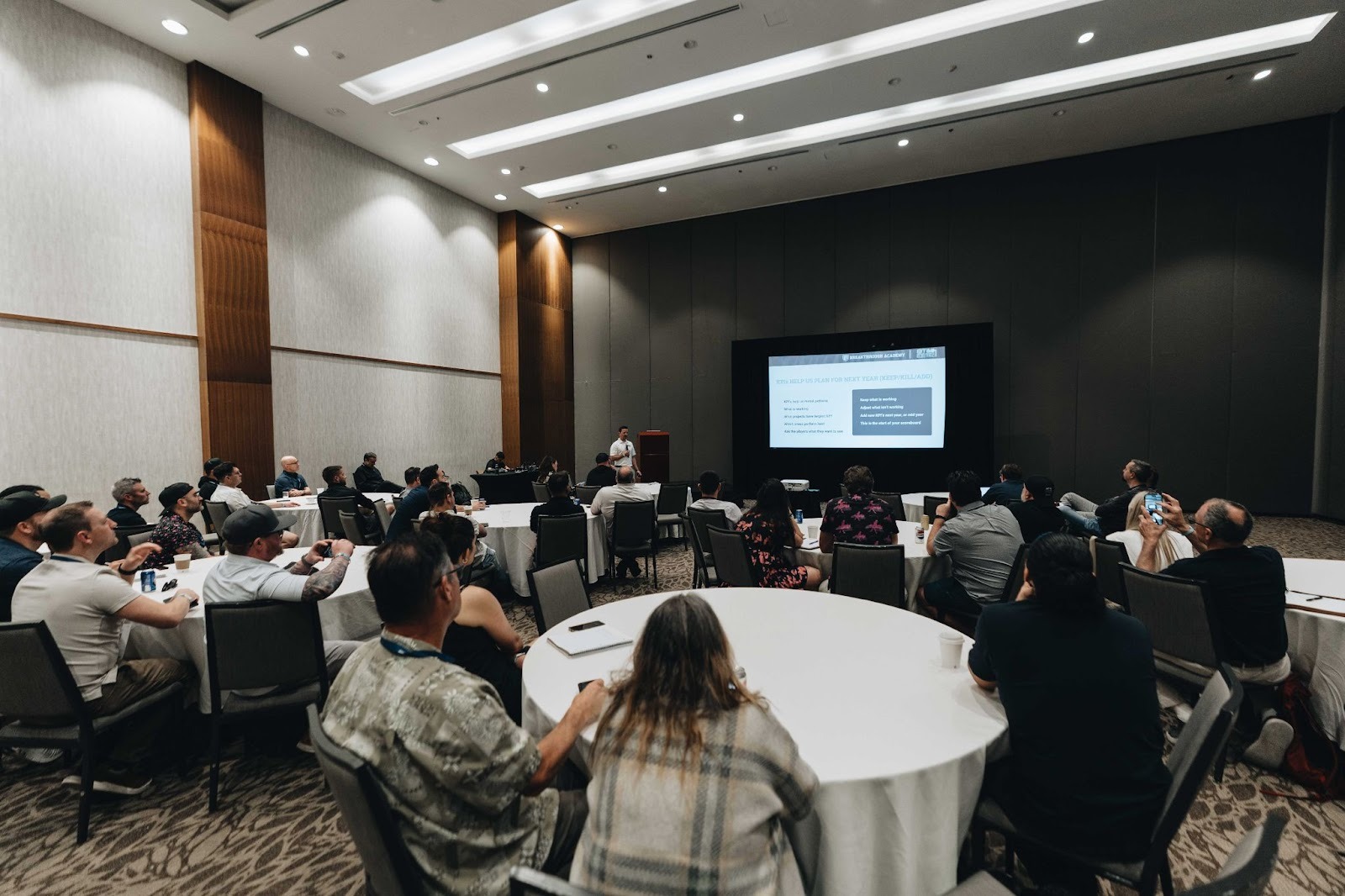
At Breakthrough Academy’s Winter Summit, electrical contractor and Breakthrough Academy Member since 2023 Noah Trombley dropped a hard truth that likely resonates with most trades business owners:
You can’t win the game if you don’t know the score.
For years, Noah and his business partner believed they were “numbers guys.” They reviewed financials, looked at revenues, and checked profits after the fact. But like many contractors, they were operating with lagging indicators. By the time they knew how a job performed, it was already done.
And once the buzzer sounds, the game’s over. You can’t change the score.
That realization led them to implement open book management — a system that shares key financial and operational numbers with employees in real time. The result? A 33% swing in labor performance and a culture shift that transformed accountability across the company.
How most contractors handle their KPIs
In competitive sports, everyone sees the score: players, coaches and fans. But in most contracting businesses, the “scoreboard” is hidden.
Employees complete jobs without knowing:
- Whether they’re ahead or behind on hours
- If material budgets are being blown
- How their performance affects profit margins
- What it actually takes to make money
Then the business owner reviews the profit and loss statement at month-end and tells the team how they did. But that’s not leadership… that’s post-mortem analysis.
How open book management changes the game
With open book management, instead of holding the numbers privately, you:
- Share key financial data (at the right level)
- Teach employees how to understand it
- Track performance frequently (think weekly, not monthly!)
- Create a visible scoreboard
- Tie performance to shared rewards (basically give employees a stake in the game)
The shift isn’t just about transparency. It’s about ownership. When people know the score, they change their behavior to win the game.
What is open book management?
Open book management is a leadership system that involves letting employees see the company’s KPIs.
But it’s not about dumping a profit and loss statement on your team. It’s about simplifying financial performance into a scoreboard that answers one question:
Are we winning or losing right now?
For construction companies and trades business owners, this typically includes the following project costs, such as:
- Revenue
- Labor hours (budget vs. actual)
- Material costs
- Gross profit
You don’t have to share salaries or every overhead detail, but you do need to share the numbers your team can influence, especially field labor performance.
Because here’s the reality:
In most trades businesses, 65–70% of costs are tied directly to labor and materials in the field.
If your field team can’t see how they’re performing, you’re leaving profit to chance.
Curious to see Noah’s entire Breakout Session? You can access it here.
Leading vs. Lagging Indicators
One of the biggest mindset shifts in open book management is understanding the difference between lagging and leading indicators. Here’s a quick rundown of the two:
Lagging indicators – Focus on the past.
Example KPIs:
- Revenue
- Net profit
- Year-end results
Leading indicators – Focus on what drives the future.
Example KPIs:
- Hours bid vs. hours used
- Change order cycle time
- Supply house runs
- Hit rate on estimates
- Work in progress accuracy
To put all this in perspective: you can’t change last quarter’s net profits (that’s a lagging indicator), but you can change this week’s labor performance (a leading indicator).
Assuming, of course, you’ve got a properly set-up scoreboard.
The power of weekly scoreboards
Noah’s company implemented a simple system:
Each project is tracked weekly, and each foreman enters one number: percentage complete.
From there, the system calculates:
- Budgeted hours
- Actual hours
- Variance (green or red)
It’s visible. It has names attached to it. And if a job starts slipping 5 to 8% over budget, the team can course correct immediately.
Compare that to reviewing a job after completion and realizing it lost money. The difference is night and day.
Does open book management work?
Before implementing high-involvement planning and open book principles, Noah’s company discovered they were 23% over on labor hours.
That’s a major profit leak.
After taking the following actions:
- Sharing the numbers
- Conducting pre-job meetings
- Aligning on hours before work begins
- Tracking weekly performance
- Reducing waste (like unnecessary supply house runs)
Their labor costs came in 9% under budget. That’s a 33% swing.
And here’s the key: it didn’t happen because management pushed harder. It happened because the field could finally see the score.
How to address common obstacles to open book management
Opening the books to your team can be a bit daunting. If you’re reading this thinking, “My team won’t care about the numbers,” you’re not alone. That’s one of the most common objections.
But in practice, most employees do care — especially when:
- The numbers are simple
- They understand how profit works
- Their performance directly impacts rewards
Another common concern: “I don’t want to share my financials.”
Fair enough. But you don’t have to share everything. Start with the most fundamental KPIs, like:
- Revenue
- Labor
- Materials
- Gross profit
Then help your team understand how profits are actually generated. Break down a dollar of revenue and show how little is left after expenses.
Most teams are shocked to learn how thin margins really are, especially on construction projects. This is where education builds trust, and trust builds accountability.
The stake in the outcome: gain sharing
Open book management works best when you give an employee ownership in the company’s success. Project managers, in particular, tend to respond very well to this approach.
That doesn’t mean giving away the company. It could look something like this:
- Set a profit target (e.g., 7% net profit)
- Everything above that threshold becomes a shared gain pool
- Distribute based on a simple formula (e.g., 50/50 split)
When the team beats the target, they win. When one department struggles, others step in to help because everyone is tied to the same scoreboard.
This creates a culture shift. From: “That’s not my problem.” To: “If we fix this, we all win.”
Hear more about how Noah grew his company with open book management by accessing the full Breakout Session.
How to implement open book management
Here’s a practical roadmap to improving profit and accountability through open book management:
1. Define your vision
Where are you going? Vision drives your KPIs, so think about where you want the following metrics to land.
- Revenue target
- Gross margin
- Net profit
- Team size
Hint! Here are a couple resources to help you get started with defining your vision or creating a strategic plan.
2. Identify 5–7 critical KPIs
Without overcomplicating anything at this point, dig a little deeper and pick out a handful of the MOST vital metrics to track.
These are metrics you’ll want to include on your scoreboard that will answer the question as to whether you’re on track or not. They could include:
- Labor variance
- Gross profit
- Estimate hit rate
- Revenue per employee
- Change order turnaround
- Incident rates
3. Build a simple scoreboard
Your scoreboard should be:
- Simple
- Quick to interpret
- Updated weekly
- Public (at least to the relevant team members… not like, public public)
Then, color code it:
🟢Green = winning
🔴Red = losing
This way, there’s no space for ambiguity.
Breakthrough Academy has a TON of experience helping contractors build easy-to-understand dashboards for their business, so don’t hesitate to reach out if you need it.
4. Train your team on financial literacy
You don’t need to don a professor’s hat or start handing out homework (unless you want to, of course), but you should make an effort to ensure your team understands:
- What gross profit means
- What overhead covers
- What net profit actually is
- Why cash matters
- How working capital is deployed
Most people were never taught this, so expect to encounter a few light bulb moments along the way.
💡💡💡
5. Turn company success into a game
Just to make DOUBLE sure no one starts thinking they’ve accidentally wandered into a classroom, consider gamifying your productivity efforts. Here’s how:
- Pick one critical number (like labor performance)
- Set a 90-day target
- Tie it to a meaningful reward
If the team achieves the goal… everybody wins. 🏆
Why open book management matters for growth-minded contractors
If you’re a contractor business owner trying to reach the next level — you’ve likely hit a ceiling where you can’t personally oversee every job anymore, but you also can’t afford profit leaks.
Open book management bridges that gap, by:
- Building leaders in the field
- Aligning incentives
- Creating transparency
- Reducing surprises
- Improving performance
- Increasing profitability
Most importantly, it turns employees into outcome owners. And that’s how you scale sustainably.
Watch the full session with Noah Trombley and switch on your scoreboard today.


Get in touch today!
Table of Contents

Get in touch today!


The business coach that lives in your inbox



You’ve built something great. Let’s make it amazing.
Ready to take your business to the next level? Let's chat.
Curious how the program will work for YOU?
You have all the right pieces of the puzzle.
We’ve helped over 1,900 contractors just like you
You don’t need to build it by yourself.
The time is now.
Over 1,900 Contractors have built businesses they’re proud of with Breakthrough Academy.
Systemizing your business is a lot of work. NOT doing it is even more.
Systemizing your business is a lot of work. NOT doing it is even more.
If you’ve read this far, it's safe to say you’ve already tried a bunch of stuff.
