


Ep -
290
63 min
What Happens When You Sell To Private Equity?
There's a lot of noise about selling to private equity in the trades right now. If you’ve considered making it your exit strategy, there’s a few things you should know about the process. Today, private equity insider Tyler Goodhue is on the show to walk us through what actually happens when you decide to sell to private equity. The good, the bad and the ugly.

Private equity has become a major talking point in the trades. Contractors are getting calls, hearing about big acquisitions and wondering whether selling could eventually be part of their own exit strategy.
But getting a strong valuation takes more than growing revenue.
In this episode of Contractor Evolution, Danny Kerr sits down with Tyler Goodhue, who has been involved in the acquisition of more than 200 businesses. They unpack what private equity firms actually look for, and what contractors should understand before considering a sale.
The big theme? Buyers are looking for businesses that can produce predictable results without depending heavily on the owner.
Whether you plan to sell or simply want to build a stronger company, here are a few things to consider.
Four Takeaways Contractors Can Apply:
- Build predictable, recurring revenue. Long-term service agreements and other contracted recurring revenue reduce risk for a potential buyer. A customer who has worked with you for years is valuable, but a signed agreement that clearly shows future revenue is much stronger.
- Reduce customer concentration. A $10 million business isn't necessarily low-risk if $8 million comes from one customer. A broader customer base makes revenue more resilient and can make your company more attractive to a buyer.
- Make the business less dependent on you. If every invoice, customer relationship and operational decision runs through the owner, the company becomes harder to transfer. Strong processes, capable managers and clear decision-making structures allow the business to perform without you being involved in every detail.
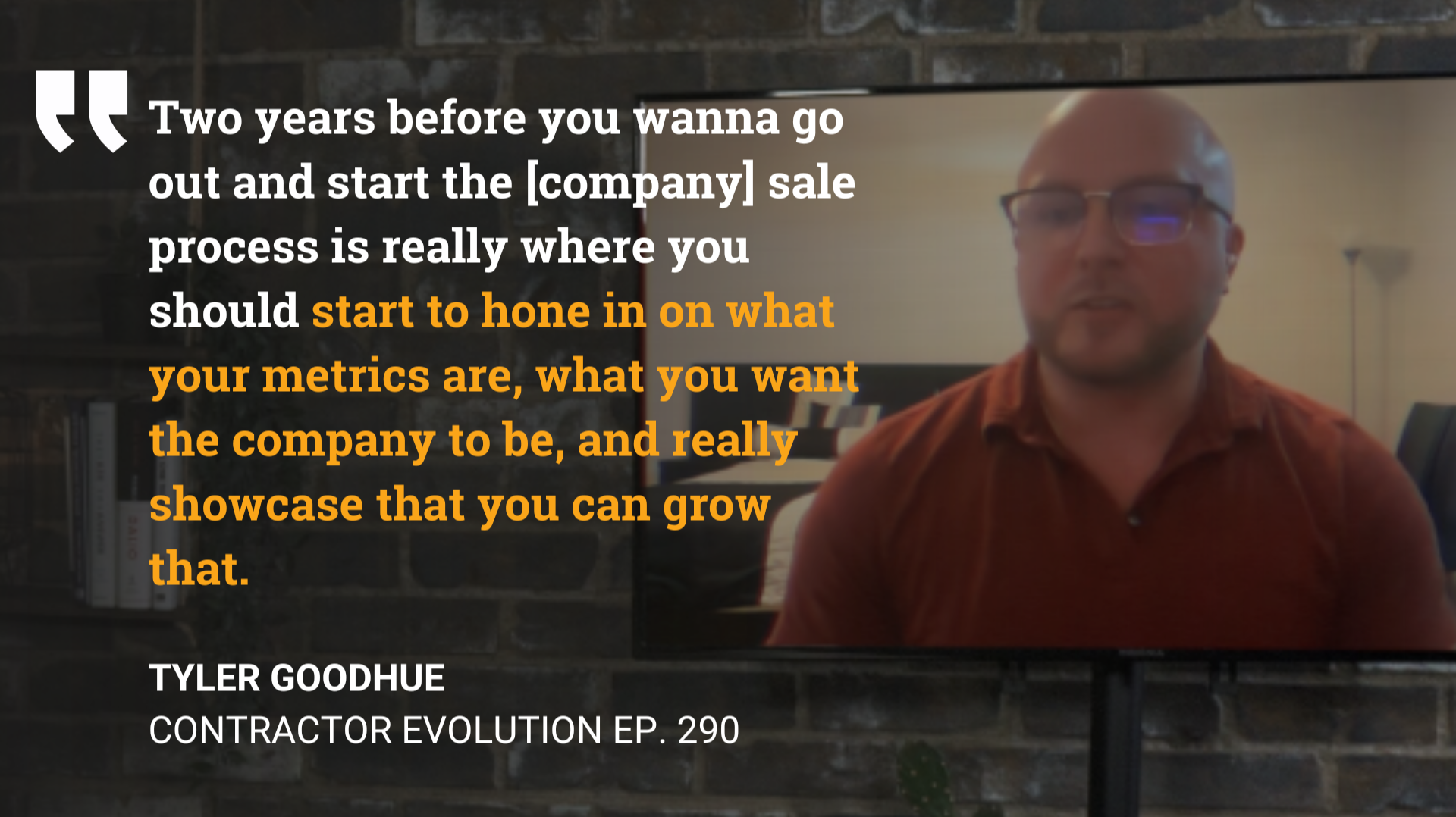
- Get serious about your data. During a sale, buyers will scrutinize your financial and operational numbers. Clean, structured data makes it easier to prove how the company performs, identify opportunities and support your valuation. Tyler recommends contractors start preparing roughly two years before they intend to begin a sale process.
And don't assume selling means cashing a cheque and immediately walking away.
Tyler explains that the process can involve months of due diligence, changes to accounting and reporting, employment agreements, earn-outs and major operational changes after the deal closes. The highest offer on paper isn't necessarily the best deal once you understand what comes with it.
The useful part is that most of what makes a contracting company attractive to private equity also makes it a better business to own: dependable revenue, less owner dependence, capable leaders, documented processes and reliable numbers.
If you want to build a contracting business that runs more predictably, relies less on you and becomes a more valuable asset, book a complimentary discovery call with Breakthrough Academy to explore how we can help.
Table of Contents


Knowledge and insights to systemize your business
You’ve built something great. Let’s make it amazing.
Ready to take your business to the next level? Let's chat.
Curious how the program will work for YOU?
You have all the right pieces of the puzzle.
We’ve helped over 1,900 contractors just like you
You don’t need to build it by yourself.
The time is now.
Over 1,900 Contractors have built businesses they’re proud of with Breakthrough Academy.
Systemizing your business is a lot of work. NOT doing it is even more.
Systemizing your business is a lot of work. NOT doing it is even more.
If you’ve read this far, it's safe to say you’ve already tried a bunch of stuff.
